
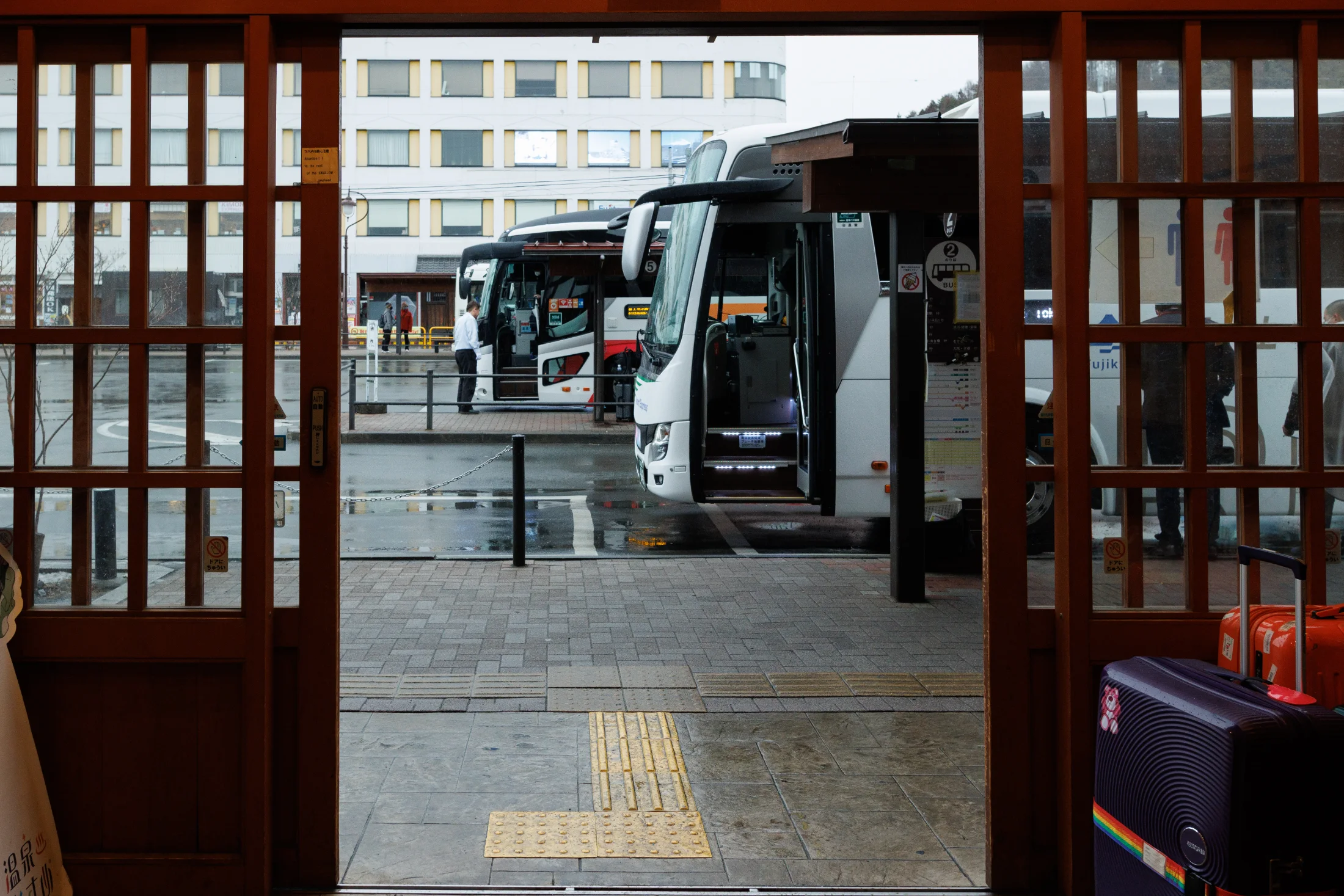
There is no single best way to travel around the Fuji Five Lakes.
A bus can save energy but leave you waiting at a rural stop. Walking provides the closest connection with the landscape but becomes impractical when roads are narrow or destinations are several kilometres apart. A rental bicycle offers freedom, although weather, traffic and the location of the rental shop can quickly change the plan.
The most effective car-free itineraries usually combine two modes:
Use the bus for the long distance, then walk or cycle within one clearly defined area.
Before choosing, consider four things:
- 1. the actual distance;
- 2. whether the route is safe for pedestrians or bicycles;
- 3. the weather and available daylight;
- 4. how you will return.
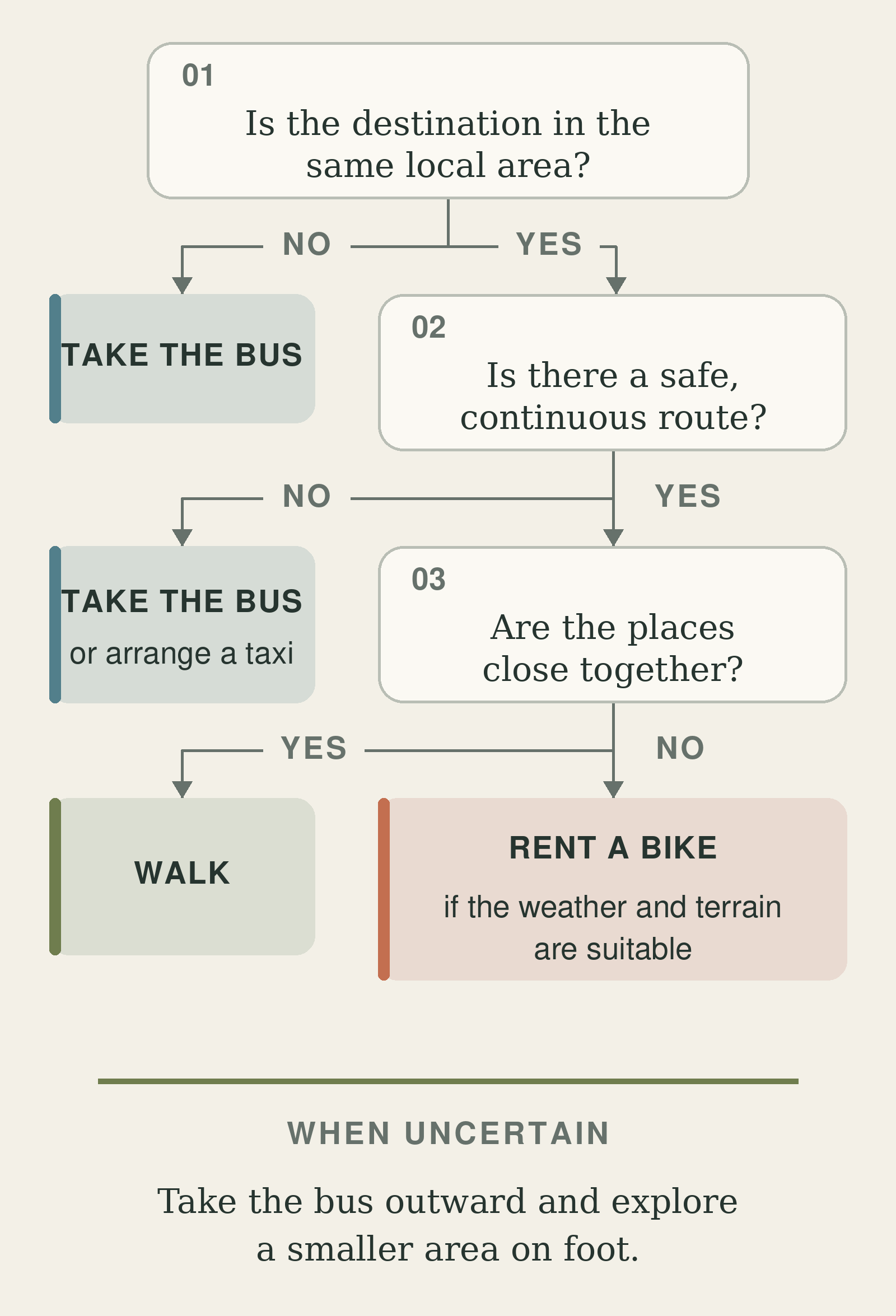
QUICK DECISION GUIDE
Take the bus when:
- You are moving between different lakes or distant areas.
- The route includes a tunnel, a busy road or long sections without a pavement.
- You need to preserve time or energy for an activity.
- The weather is unsuitable for walking or cycling.
- You already know the departure time of your return bus.
Walk when:
- Your destinations are close together.
- There is a continuous pavement, lakeside path or official trail.
- The journey itself is part of what you want to experience.
- You have enough daylight and suitable shoes.
Rent a bike when:
- Several places are spread around the same lake or district.
- The roads and paths are suitable for your level of experience.
- The weather is stable.
- You can return the bicycle before the rental shop closes.
- You do not need to carry large luggage.
Start with the real route, not the distance
A digital map may show that two places are only three kilometres apart. It does not tell you whether the road has a pavement, whether there is a tunnel, how much traffic uses it or whether the final section climbs steeply away from the lake.
Around Kawaguchiko, a short distance may follow a comfortable lakeside path. Around the quieter lakes, the same distance may require walking beside a road with little separation from passing vehicles.
Before deciding to walk or cycle, inspect:
- the type of road;
- the presence of a pavement or cycling path;
- elevation changes;
- tunnels and narrow bridges;
- the location of the next bus stop;
- the time at which it becomes dark;
- the expected weather.
Do not assume that a route is suitable simply because a navigation app offers walking or cycling directions.
When the bus is the right choice
The bus is usually the most sensible option for travelling between separate parts of the Fuji Five Lakes.
Use it to reach the north shore of Kawaguchiko, the main sites around Saiko, the western lakes or the Yamanakako area. Once there, walking can replace repeated short bus journeys.
The bus is particularly useful when:
- Your activity requires energy, such as hiking or kayaking.
- You are travelling with children or substantial luggage.
- Rain, heat, snow or strong wind makes cycling uncomfortable.
- The road between two areas is unsuitable for casual walking.
- You want to begin a one-way walk and return from a different stop.
The limitation is that buses follow their own timetable rather than yours.
The Red Line around Kawaguchiko operates much more frequently than services towards Shojiko or Motosuko. A missed bus on the north shore of Kawaguchiko may be an inconvenience; missing a return from a quieter lake can affect the rest of the day.
Always check the return journey before leaving. Current western sightseeing routes are published on the official Fujikyu Bus website.
BUS RULE
- If there is only one return bus that allows you to complete the rest of your journey, plan to use the bus before it.
- This leaves an alternative if your walk takes longer than expected, the road is busy or the first bus is delayed or full.
The bus is not always faster
Around central Kawaguchiko, a short walk may be faster than waiting for the next bus, particularly when road traffic is heavy.
Compare the complete journey:
- walking time to the stop;
- time spent waiting;
- time on the bus;
- walking from the arrival stop;
- possible traffic delays.
If two places are safely connected and only a short walk apart, boarding a crowded bus may save very little time.
When walking is the right choice
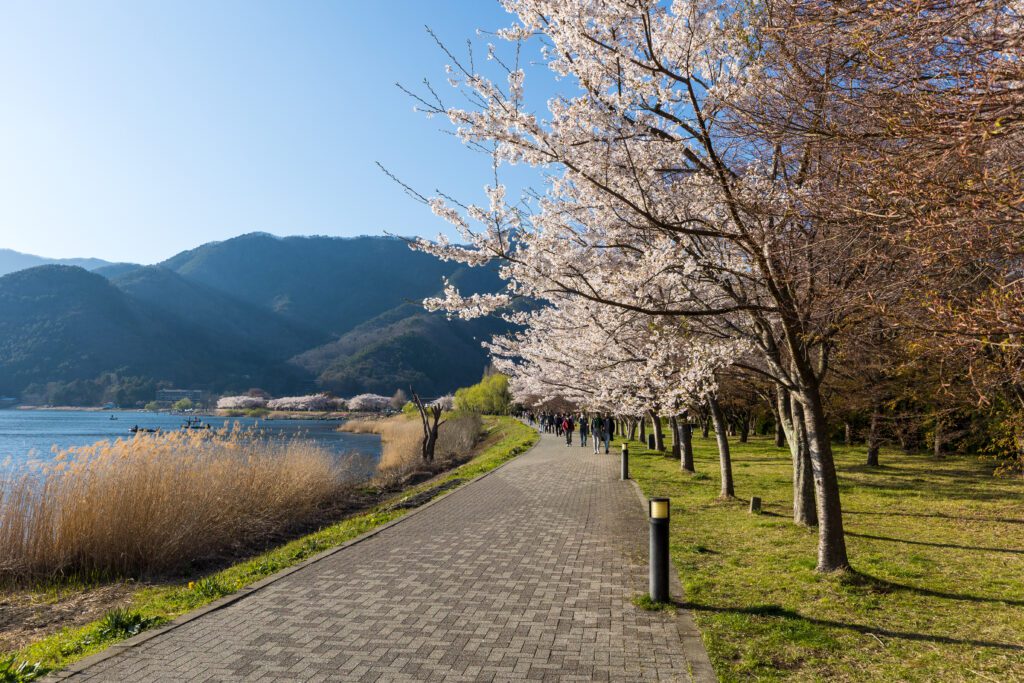
Walking is the best way to experience a compact area.
It allows you to notice small shrines, local shops, changes in vegetation and viewpoints that are easily missed from a vehicle. It also removes the need to repeatedly check a timetable.
Walking works particularly well for:
- sections of the Kawaguchiko lakeshore;
- groups of museums and gardens on the north shore;
- central Fujiyoshida;
- villages and small local districts;
- recognised lakeside paths;
- official trails around Saiko and Jukai;
- short connections between a bus stop and one principal destination.
A useful approach is to take the bus to the farthest point you intend to visit, then walk back through a series of nearby places.
This is generally better than walking outward without knowing how much time or energy will remain for the return.
When not to walk
Choose another mode when:
- The road has no safe space for pedestrians.
- The route passes through a long or narrow tunnel.
- Heavy rain, snow or ice affects the surface.
- You would need to finish after dark.
- Your destination is only the beginning of a longer activity.
- The final return bus leaves little margin for delays.
- You are carrying large bags or unsuitable footwear.
The road around a lake is not necessarily a walking trail. Some lakeside sections are pleasant, while others were designed primarily for vehicles.
Walking in Jukai
Only use official, marked trails in Aokigahara Jukai.
Do not follow an apparent shortcut between two roads or attractions, even if it looks shorter on a map. Forest terrain, exposed roots and multiple junctions make distance a poor indication of walking time.
Closed shoes, water and a bear bell are recommended. If you are uncertain about the route, return to the last permanent sign you recognised.
When a rental bicycle is the right choice
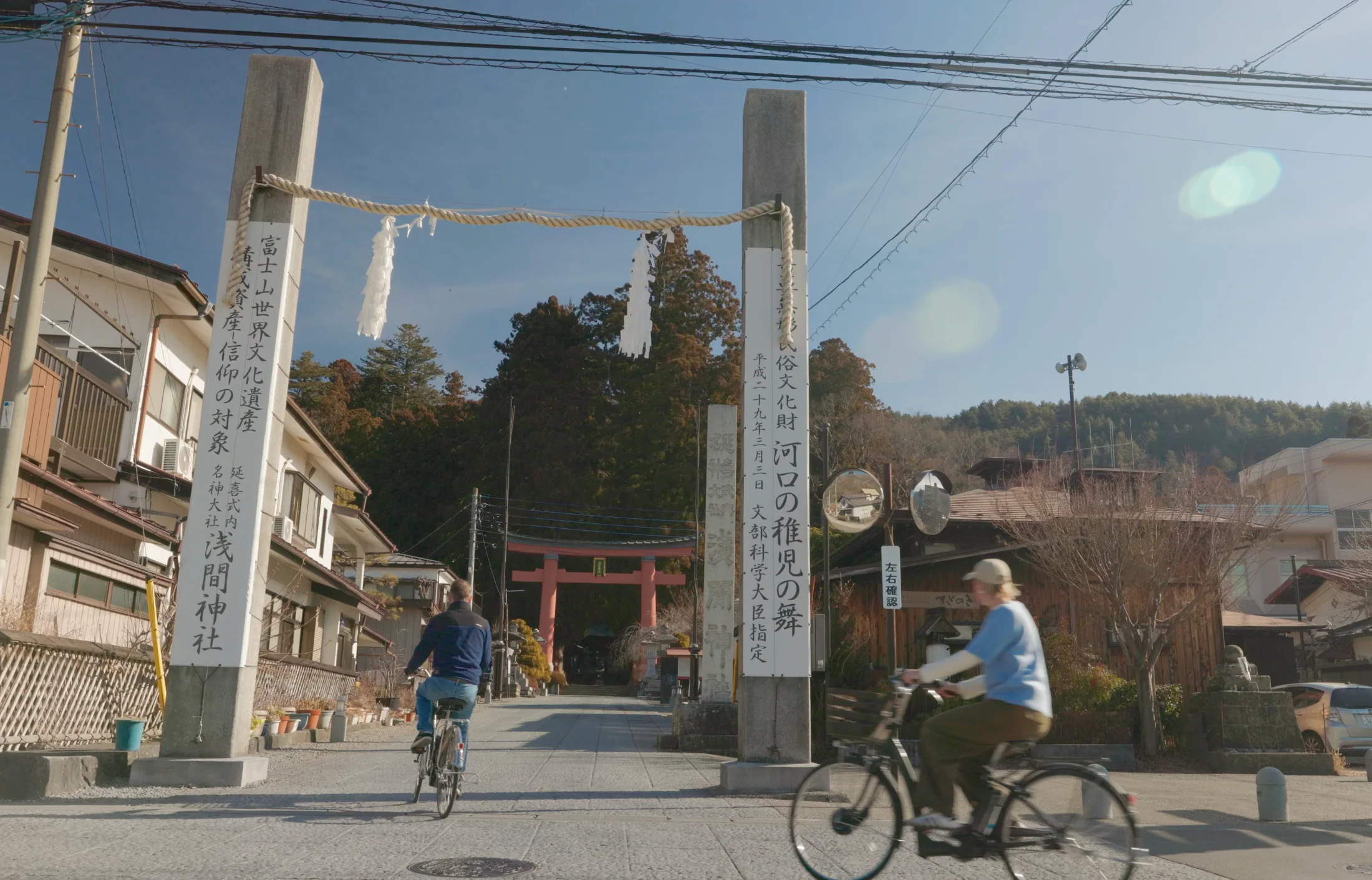
A bicycle is useful when destinations are too far apart for a comfortable walk but remain within the same local area.
It gives you more freedom than a bus and allows you to stop at smaller parks, viewpoints and shops. However, it is most effective as a local exploration tool, not as a replacement for a car across the entire Fuji Five Lakes region.
Rent a bicycle when:
- You want to explore several points around one lake.
- The rental and return location fits your itinerary.
- You are comfortable riding beside traffic where necessary.
- You have checked the weather.
- You have enough time to return before closing.
- You can leave large luggage elsewhere.
Standard bicycle or electric bicycle?
A standard city bicycle is suitable for relatively flat, short rides in good conditions.
Choose an electric bicycle when:
- You are travelling beyond the immediate lakeshore.
- Your route includes repeated slopes.
- You are not accustomed to cycling regularly.
- You want to preserve energy for walking or another activity.
- You expect to cover a larger part of the day by bicycle.
Electric assistance does not remove the need to pedal, control the bicycle or ride safely in traffic. It also introduces a battery limit.
Before leaving the rental shop, check:
- the remaining battery level;
- the expected range;
- how to lock the bicycle;
- the return deadline;
- whether the bicycle may be left at another location;
- what to do in case of a puncture or mechanical problem;
- whether a helmet is included;
- whether the rental continues during rain.
Do not assume you can take the bicycle on a bus
Ordinary sightseeing buses are not designed to carry assembled rental bicycles.
Do not create an itinerary that depends on boarding a bus with your bicycle unless both the bus operator and rental company have explicitly confirmed that it is permitted.
In most cases, you should plan to return the bicycle to its designated rental location under your own power.
Choosing by area
Kawaguchiko
Use the bus when:
- Travelling from the station to the north shore or Oishi area.
- You want to reach the farthest point first.
- Weather or traffic makes cycling uncomfortable.
- You need to connect with Saiko afterwards.
Walk when:
- Exploring several nearby places along the shore.
- Moving around the Funatsu area near the station.
- Visiting a compact group of museums, gardens or cafés.
- You have confirmed that the chosen section has a safe pedestrian route.
Rent a bike when:
- You want more flexibility than the Red Line provides.
- You plan to explore several separated parts of the lake.
- You understand that infrastructure and traffic conditions change around the circuit.
Kawaguchiko is well suited to combining all three modes: bus for the first long section, walking through one area and cycling on a separate day.
Saiko and Jukai
Use the bus when:
- Reaching Saiko from Kawaguchiko.
- Travelling to Saiko Bat Cave, Iyashi-no-Sato, Wild Bird Forest or Fugaku Wind Cave.
- The forest walk is the main activity of the day.
Walk when:
- Following a recognised official forest trail.
- Exploring the village or one defined section of lakeshore.
- Moving between places whose pedestrian route has been checked.
Rent a bike when:
- You are comfortable riding on rural roads.
- The bicycle is available near your starting point.
- You have confirmed the complete route and return arrangements.
Saiko is quieter than Kawaguchiko, but quiet does not automatically mean easy. Services are more dispersed, and some roads provide limited space for pedestrians and casual cyclists.
Shojiko and Motosuko
For most first-time car-free visitors, the bus should provide the principal journey to Shojiko or Motosuko.
Once there, walk within one defined area rather than trying to cover the entire shoreline.
Bicycle rental is available in parts of the western area, including seasonally around the Motosuko Tourist Information Center. Availability should be checked before travelling, particularly outside the warmer months. Current general information is available through the official Mt. Fuji West Side transport guide.
A bicycle can be useful for reaching a particular viewpoint from the main Motosuko access area. It should not be treated as an automatic way to travel between Saiko, Shojiko and Motosuko. The connecting roads include faster traffic, elevation changes and sections unsuitable for inexperienced riders.
Yamanakako
Yamanakako is one of the strongest choices for a cycling day.
The lake is approximately 14 kilometres around, and a dedicated cycling path covers about 80 percent of the shoreline. The remaining sections still require attention to road conditions and traffic.
The official Yamanashi tourism guide estimates approximately one and a half hours for a continuous circuit by city bicycle. This does not include long stops, meals, photographs or visits, so allow considerably more time if cycling is part of a full sightseeing day.
See the official Lake Yamanakako Cycling Road guide for current general information.
Use the bus when:
- Reaching Yamanakako from Fujisan or Kawaguchiko Station.
- Travelling to one particular side of the lake.
- Weather conditions are poor.
- You do not intend to complete a circuit.
Walk when:
- Exploring one section of the shoreline.
- Moving between nearby parks, cafés or viewpoints.
- You have enough time and do not need to return to a distant rental location.
Rent a bike when:
- You want to experience several sides of the lake.
- Conditions are dry and not excessively windy.
- You can comfortably complete the planned distance.
- You have checked where the cycling path ends and road riding begins.
The best combinations
Bus out, walk back
This is usually the simplest combination around Kawaguchiko.
Take the bus to the farthest stop, then walk through several nearby areas in the general direction of your accommodation or a frequently served stop.
Bus to one area, then rent a bike
This can work well around Yamanakako or at a destination with a confirmed local rental service.
Check the final rental return time before selecting the bus back. The bus timetable and bicycle deadline must both fit the plan.
Bus to a trail, then walk
Use public transport to reach a recognised trailhead around Saiko or Jukai. Complete the walk with enough time to locate the correct return stop.
Do not select a one-way trail solely because a bus stop appears near the end on a digital map. Verify that the stop is served in the required direction and at the required time.
Walk first, bus back
This works only when the return service is frequent enough and you already know the correct stop.
It is less suitable around Shojiko, Motosuko or remote parts of Saiko, where missing one departure can create a long wait.
Let the weather change the decision
The best transport plan in the morning may no longer be sensible in the afternoon.
Rain
Light rain may still allow a short walk with suitable clothing. It makes roots, painted surfaces, metal covers and fallen leaves more slippery.
Cycling becomes less comfortable and visibility is reduced. In persistent rain, use the bus and choose fewer destinations.
Strong wind
Wind can make cycling tiring even on a flat route, particularly beside an open lake. It can also affect bicycle control and turn an easy return into a difficult ride.
If the wind is expected to increase, do not rely on cycling back from the far side of a lake.
Summer heat
The Fuji Five Lakes are cooler than central Tokyo, but exposed roads and lakeside paths can still become hot.
Carry water, use sun protection and avoid estimating a long walk solely from the air temperature at the start of the day.
Winter
Snow, ice and short daylight hours can make both walking and cycling unsuitable.
Some rental services close seasonally. Shaded roads may remain icy even when the main streets appear clear. Use public transport and confirm that your intended destination is open.
Common mistakes
- Choosing a mode based only on the straight-line distance.
- Assuming every lakeshore has a continuous walking path.
- Renting a bicycle without checking the return deadline.
- Beginning a complete lake circuit too late in the day.
- Assuming an electric bicycle makes every road suitable.
- Planning to carry a normal rental bicycle onto a bus.
- Walking outward without checking the return route.
- Relying on one final rural bus with no alternative.
- Ignoring wind because the route appears flat.
- Trying to combine several lakes simply because a bicycle feels more flexible than a bus.
A final rule
Choose the mode that fits the least convenient part of the journey.
If most of the route is walkable but one section includes a dangerous road, take the bus. If the bicycle ride is easy but the rental shop closes before your return, choose another plan. If the bus reaches the area but leaves no time to experience it, reduce the number of destinations.
The objective is not to cover the greatest distance.
Use the bus to reach the right area, walk when the route deserves your attention and rent a bicycle when it provides genuine freedom rather than creating another deadline.
For a broader transport overview, see Getting Around the Fuji Five Lakes Without a Car.