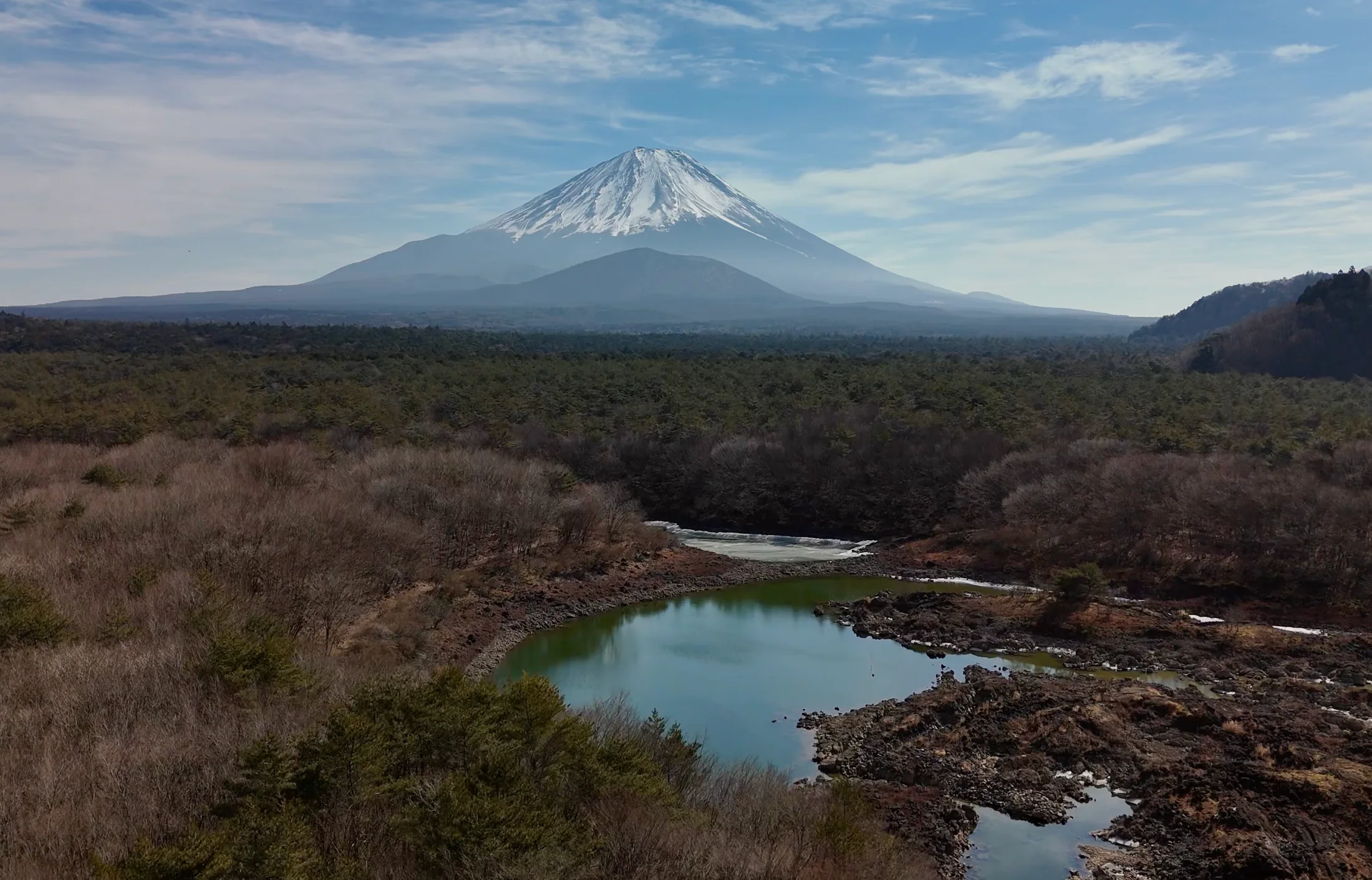
The name is often used loosely in travel guides, hotel listings and tour descriptions. This can make the area appear like a compact group of neighboring lakes that visitors can easily move between.
In reality, the Fuji Five Lakes—known in Japanese as Fujigoko or 富士五湖—form a much larger and more varied region along the northern side of Mount Fuji in Yamanashi Prefecture.
The five lakes are:
- Lake Yamanakako
- Lake Kawaguchiko
- Lake Saiko
- Lake Shojiko
- Lake Motosuko
They share a connection to Mount Fuji, but they are not interchangeable. Each lake has its own landscape, surrounding communities, transport options and relationship with the mountain.
Understanding that distinction makes it much easier to plan a visit.
Where Are the Five Lakes?
The lakes stretch from east to west across the northern base of Mount Fuji.
From west to east, they are:
Motosuko → Shojiko → Saiko → Kawaguchiko → Yamanakako
Kawaguchiko is the best-known visitor base and has the region’s main concentration of hotels, restaurants and public transportation. Yamanakako lies farther east, while the three western lakes—Saiko, Shojiko and Motosuko—are surrounded by more forest and generally have less development.
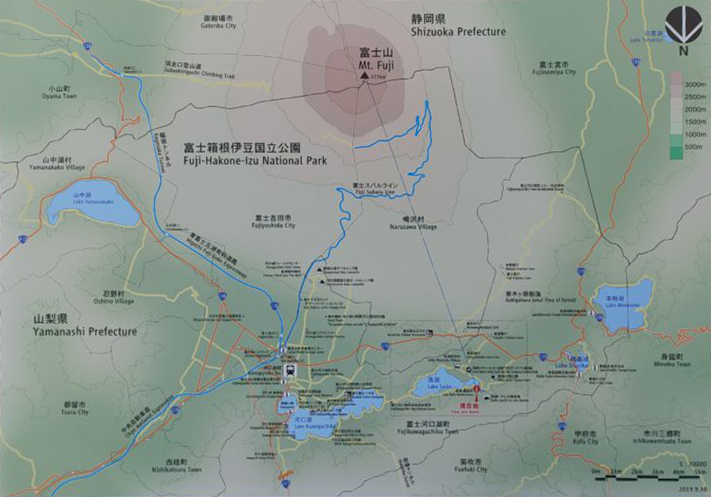
The entire chain covers a substantial distance. It should be understood as a region rather than a single walkable resort.
A Small Language Note
The Japanese word ko, written 湖, means “lake.”
Kawaguchiko therefore already means “Lake Kawaguchi.” Similarly, Yamanakako means “Lake Yamanaka.”
English-language signs and travel articles sometimes say “Lake Kawaguchiko” or “Lake Yamanakako.” This is technically repetitive, but it has become common usage and is generally understood.
Why These Particular Five Lakes?
The group is not simply a modern tourism label.
The lakes share a volcanic landscape shaped by Mount Fuji, as well as a long cultural connection to the mountain. Lakes, springs, lava fields, caves and forested areas around Fuji became part of pilgrimage and religious practices associated with the mountain.
Before climbing, pilgrims used lakes and springs for ritual purification. Routes known as Hakkaimeguri, or circuits of eight lakes, developed among followers of Fuji worship. The precise lakes included in those circuits changed over time, but the present Fuji Five Lakes repeatedly appeared as important sacred places.
This historical relationship is one reason the lakes are more than scenic viewpoints. They belong to a wider cultural landscape connected to worship, pilgrimage and artistic representations of Mount Fuji. UNESCO describes these religious and artistic associations as central to the significance of Fujisan.
The Lakes Were Created by Volcanic Activity
All five lakes owe their existence to the volcanic landscape around Mount Fuji.
Over thousands of years, lava flows blocked valleys and waterways, changing drainage patterns and creating natural basins in which water accumulated. The result was the system of lakes found around Fuji’s northern foothills today. Yamanashi’s official tourism information provides an overview of this volcanic origin.
The geological story is especially visible around the three western lakes.
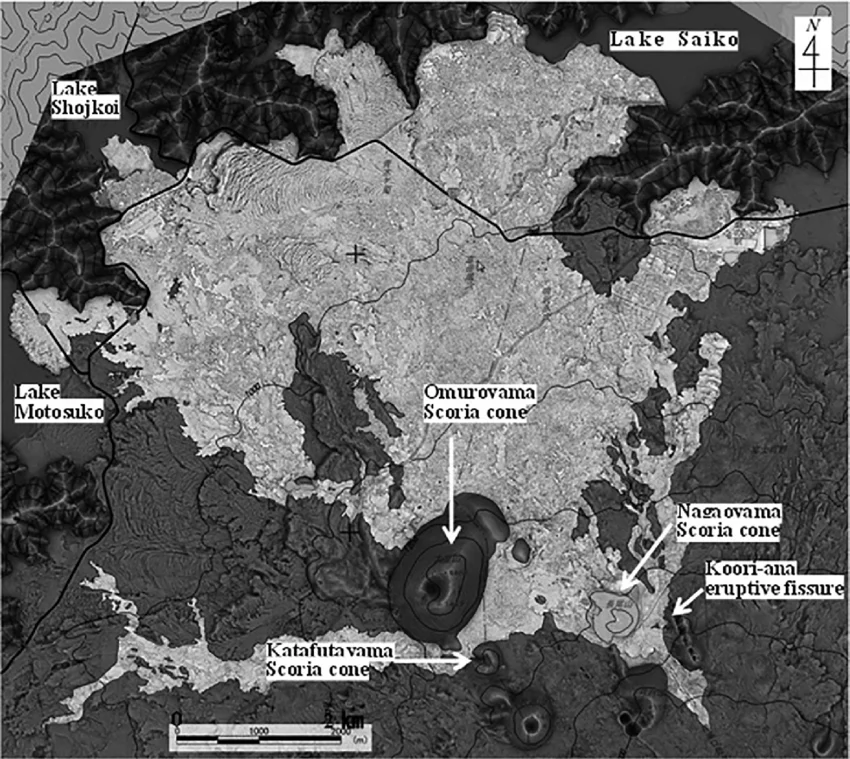
Saiko, Shojiko and Motosuko were once connected as part of a much larger body of water. During the Jōgan eruption of 864, lava flowed across the area and divided that water into separate lakes.
The same lava created much of the rocky foundation beneath Aokigahara Forest, which now extends around the western side of Mount Fuji.
The three lakes remain at approximately the same elevation, and evidence suggests that water can still move between them through the porous volcanic ground.
Part of a Cultural World Heritage Site
In 2013, Mount Fuji was added to the UNESCO World Heritage List as “Fujisan, sacred place and source of artistic inspiration.”
It was inscribed as a cultural property rather than a natural one.
The designation recognizes not only the mountain itself, but also a network of sites connected to Fuji worship, pilgrimage and art. All five lakes are included within this wider World Heritage property.
This distinction matters. The lakes are not protected merely because they offer attractive views. They help explain how people have experienced, worshipped and represented Mount Fuji over centuries.
The familiar image of Fuji rising beyond a lake is therefore part of a much older visual and cultural tradition.
One Name, Five Different Landscapes
Although the lakes share a regional identity, they do not provide the same experience.
Lake Kawaguchiko
Kawaguchiko is the most developed and most frequently visited of the five lakes.
It has the strongest public transport connections, the widest choice of accommodation and the largest concentration of conventional visitor attractions. For many first-time travelers, it serves as the practical gateway to the region.
However, “Fuji Five Lakes” and “Kawaguchiko” are not synonyms. Staying at Kawaguchiko does not mean that the other four lakes are immediately nearby.
Lake Yamanakako
Yamanakako is the largest of the five lakes.
Its wider, more open landscape creates a different atmosphere from the forested western lakes. The area is associated with cycling, water activities, holiday homes and outdoor recreation.
It lies east of Kawaguchiko and functions largely as a separate destination.
Lake Saiko
Saiko is surrounded by steep, heavily forested slopes.
Its connection with Aokigahara gives it a quieter and more enclosed character. Mount Fuji is not visible from every part of the shoreline; the clearest views are generally found toward the western end of the lake.
Lake Shojiko
Shojiko is the smallest of the five lakes.
It has comparatively little large-scale development and feels more intimate than Kawaguchiko or Yamanakako. One of its best-known views shows Mount Fuji rising behind the smaller Mount Omuro, creating the impression that Fuji is cradling another mountain.
Lake Motosuko
Motosuko is the westernmost and deepest of the five lakes.
It is surrounded by forest and has relatively limited development around much of its shoreline. Its open water and natural setting make it particularly attractive for camping, paddling and other outdoor activities.
QUICK REFERENCE
- Largest lake: Yamanakako
- Smallest lake: Shojiko
- Deepest lake: Motosuko
- Main transport and accommodation hub: Kawaguchiko
- Most closely enclosed by forest: Saiko
For a fuller comparison, see [Which Fuji Lake Should You Visit?]
“Fuji Five Lakes” Can Also Mean the Wider Region
In everyday tourism language, the term is often used more broadly than the five shorelines themselves.
A hotel, restaurant or attraction described as being “in the Fuji Five Lakes area” may actually be located in:
- Fujikawaguchiko
- Fujiyoshida
- Oshino
- Narusawa
- Another community around Fuji’s northern foothills
These places belong to the wider visitor region, but they are not necessarily beside one of the lakes.
This is especially important when choosing accommodation. A property advertised as being in the Fuji Five Lakes area could be several kilometers from the nearest shoreline, far from Kawaguchiko Station or difficult to reach without a car.
Always check its exact position on a map rather than relying on the regional label.
The Five Lakes Are Not One Continuous Resort
A common planning mistake is to imagine the lakes as five stops along a simple lakeside road.
There is no train connecting all five, and public transport becomes less frequent toward the western lakes. The region also includes forests, towns, foothills and long stretches of road between the main visitor areas.
Walking between the lakes is generally not a practical sightseeing strategy.
Even with a car, trying to visit all five in one day often produces more driving than meaningful exploration. Without a car, it is usually better to choose one main area and make a carefully selected excursion from there.
For transport planning, see [Getting Around the Fuji Five Lakes Without a Car].
Do All Five Lakes Have the Same View of Mount Fuji?
No.
The visibility, shape and scale of Mount Fuji change considerably from one lake to another—and sometimes from one side of the same lake to the other.
Several factors affect the view:
- The orientation of the shoreline
- Nearby hills and mountains
- Forest cover
- Buildings
- The distance from Mount Fuji
- Cloud and weather conditions
At Saiko, for example, surrounding terrain blocks the mountain from much of the shoreline. Kawaguchiko and Yamanakako have larger open viewing areas, but even there, some shores face away from the mountain or have partial views.
The phrase “lake with a Mount Fuji view” should never be treated as a guarantee that Fuji will be visible from every location.
See [Why Mount Fuji Is Not Always Visible] for more on weather, seasonal patterns and timing.
How Many Lakes Should You Visit?
There is no need to visit all five simply because they belong to the same group.
For most travelers, one or two well-chosen lakes will provide a more satisfying experience than a rushed circuit of all five.
A first-time visitor relying on public transport might use Kawaguchiko as a base and explore one part of the lake carefully. Someone interested in forests and volcanic landscapes might combine Saiko with Aokigahara. A traveler with a car and an interest in quieter scenery might concentrate on Shojiko and Motosuko.
The number of lakes matters less than choosing an area that suits your interests, transportation and available time.
The Meaning Behind the Name
“Fuji Five Lakes” describes five specific lakes, but it also refers to a connected volcanic and cultural landscape.
The lakes were shaped by eruptions, incorporated into traditions of pilgrimage and worship, and repeatedly represented as part of the image of Mount Fuji. Today, they form one of Japan’s best-known mountain regions—but they remain five distinct places rather than five versions of the same destination.
Think of the Fuji Five Lakes as a region to understand, not a checklist to complete.
Continue Planning
- [Which Fuji Lake Should You Visit?]
- [Getting Around the Fuji Five Lakes Without a Car]
- [When to Use the Bus, Walk or Rent a Bike]
- [Why Mount Fuji Is Not Always Visible]
For practical transport planning, see Getting Around the Fuji Five Lakes Without a Car.