
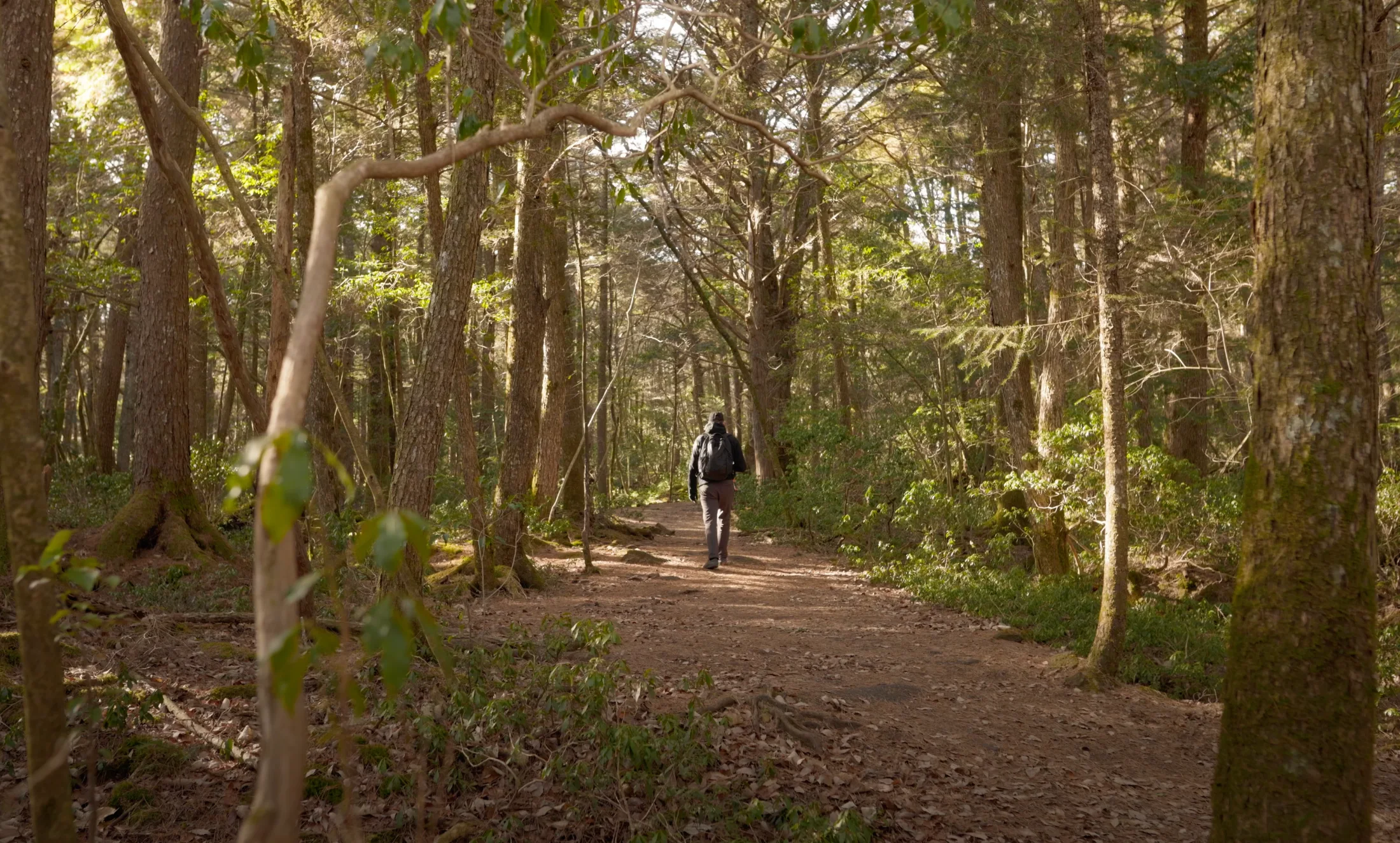
Aokigahara Jukai
is often described from the outside through myths and sensational stories. They say very little about what the forest is actually like.
On the official trails, Jukai is neither a frightening attraction nor an ordinary woodland walk. It is a quiet volcanic landscape where trees grow over hardened lava, roots spread across the surface and moss covers the ground in a thin, fragile layer. To appreciate it, it helps to slow down, stay on the marked paths and pay attention to details that are easy to miss.
This guide focuses on the walking trails around Lake Saiko, particularly those beginning near Saiko Bat Cave and leading towards Wild Bird Forest or Ryugu Cave.
PRACTICAL INFORMATION
- Starting point: Saiko Nature Center and Saiko Bat Cave
- Difficulty: Easy to moderate, with uneven volcanic ground
- Best seasons: Spring to autumn
- Public transport: Saiko Sightseeing Bus — Green Line
- Facilities: Toilets and visitor facilities at the Nature Center, but none along the forest trails
- Essential equipment: Closed shoes with good grip, water, an additional layer and a bear bell
A forest born from an eruption
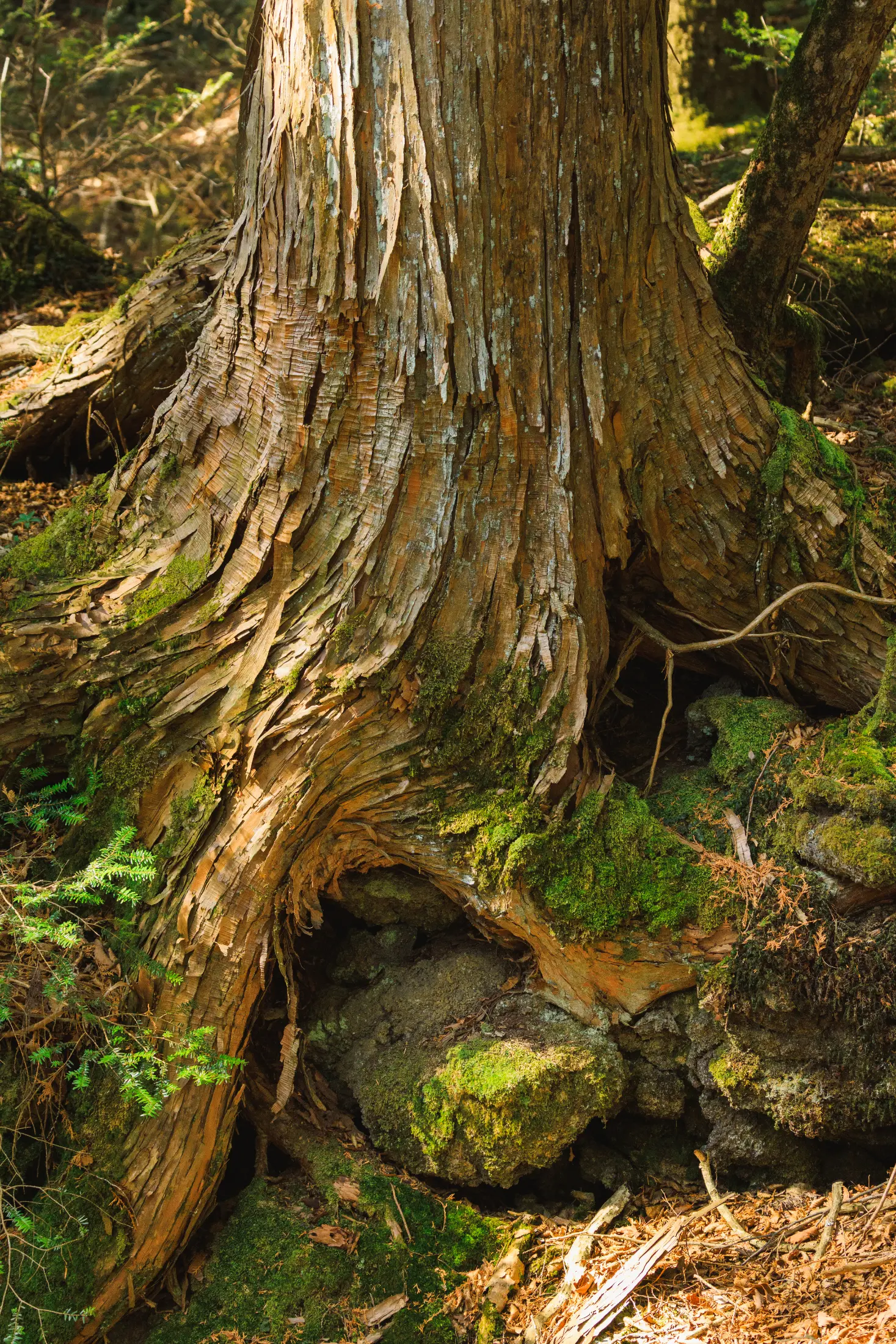
The forest developed over lava produced during Mount Fuji’s eruption of 864–866. Unlike an older forest with deep soil, much of Jukai grows directly over volcanic rock.
Soil has gradually accumulated in small pockets, but many trees are still unable to send their roots far into the ground. Instead, the roots spread sideways across the lava, twisting around rocks and one another. Fallen trees, exposed roots, small cavities and patches of moss are all part of this unusual landscape.
This also explains why the forest is more delicate than it first appears. Moss can take a long time to recover after being stepped on, while damage to roots or bark may weaken trees growing in already difficult conditions.
What walking in Jukai really feels like
The first thing many people notice is the quiet.
The canopy softens the light, while the irregular ground naturally slows your pace. Away from the road, there may be long stretches when all you hear are your own footsteps, a few birds and the movement of the trees.
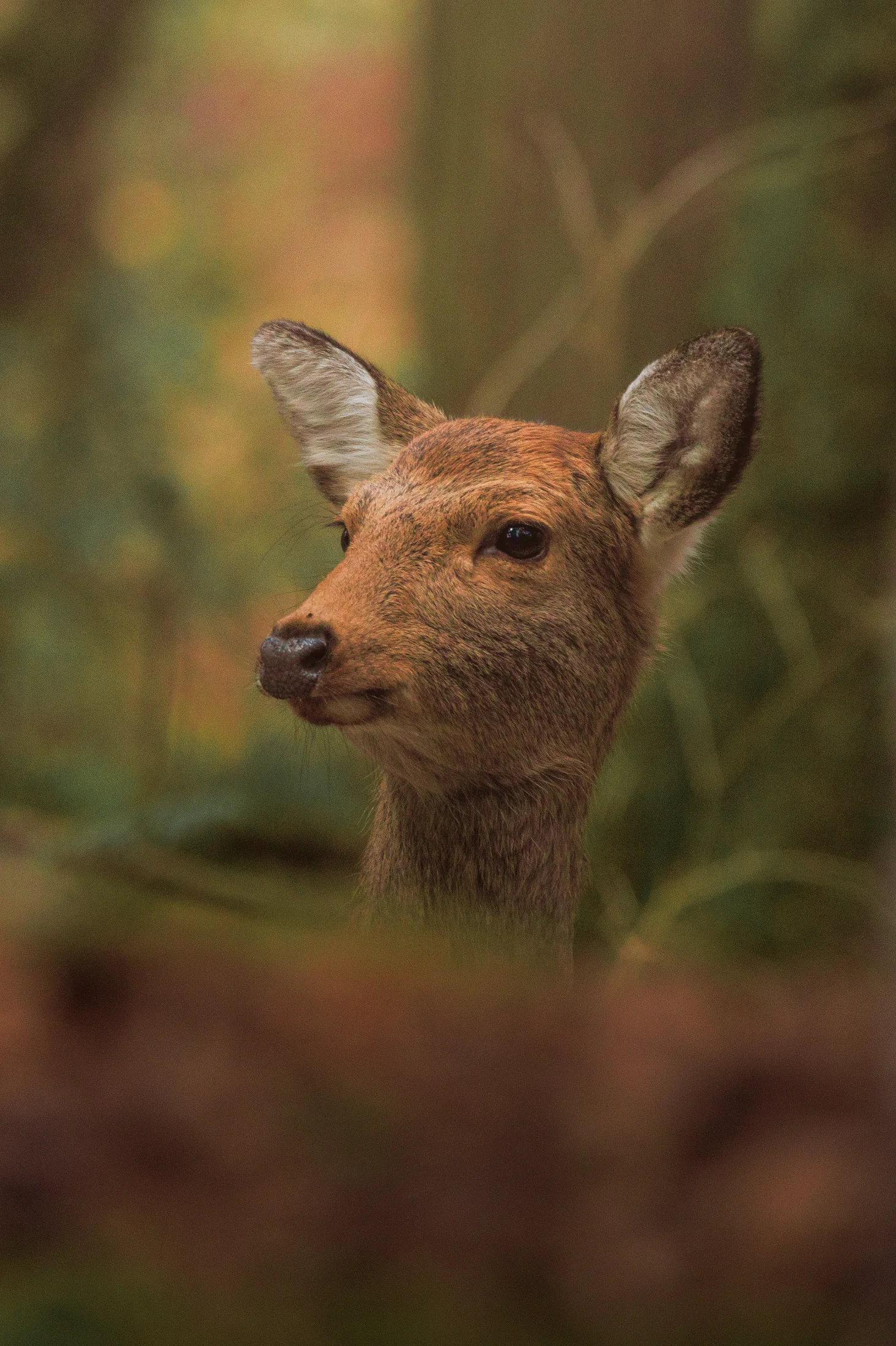
Wild animals live throughout the forest, including birds, squirrels, deer and other mammals, but seeing them is never guaranteed. In Jukai, you will often hear wildlife before you see it.
During one of our recent walks with a family, a child was talking loudly as we moved through the forest. Somewhere among the trees, a sika deer gave a sharp warning call. It had noticed us, but we never saw it.
It was a good reminder that spotting wildlife is not simply a matter of looking harder. If you want to experience the living forest, the best thing you can do is slow down, listen and accept that the animals may remain hidden.
Where to begin
For a first visit, the area around Saiko Nature Center and Saiko Bat Cave is one of the most practical starting points.
There are toilets, visitor facilities and access to a network of marked walking trails. The official paths connect the Bat Cave area with Wild Bird Forest, the Lake Saiko side of the forest, Ryugu Cave and routes continuing towards Fugaku Wind Cave.
Two walks are particularly useful for discovering this part of Jukai.
Saiko Bat Cave and Wild Bird Forest
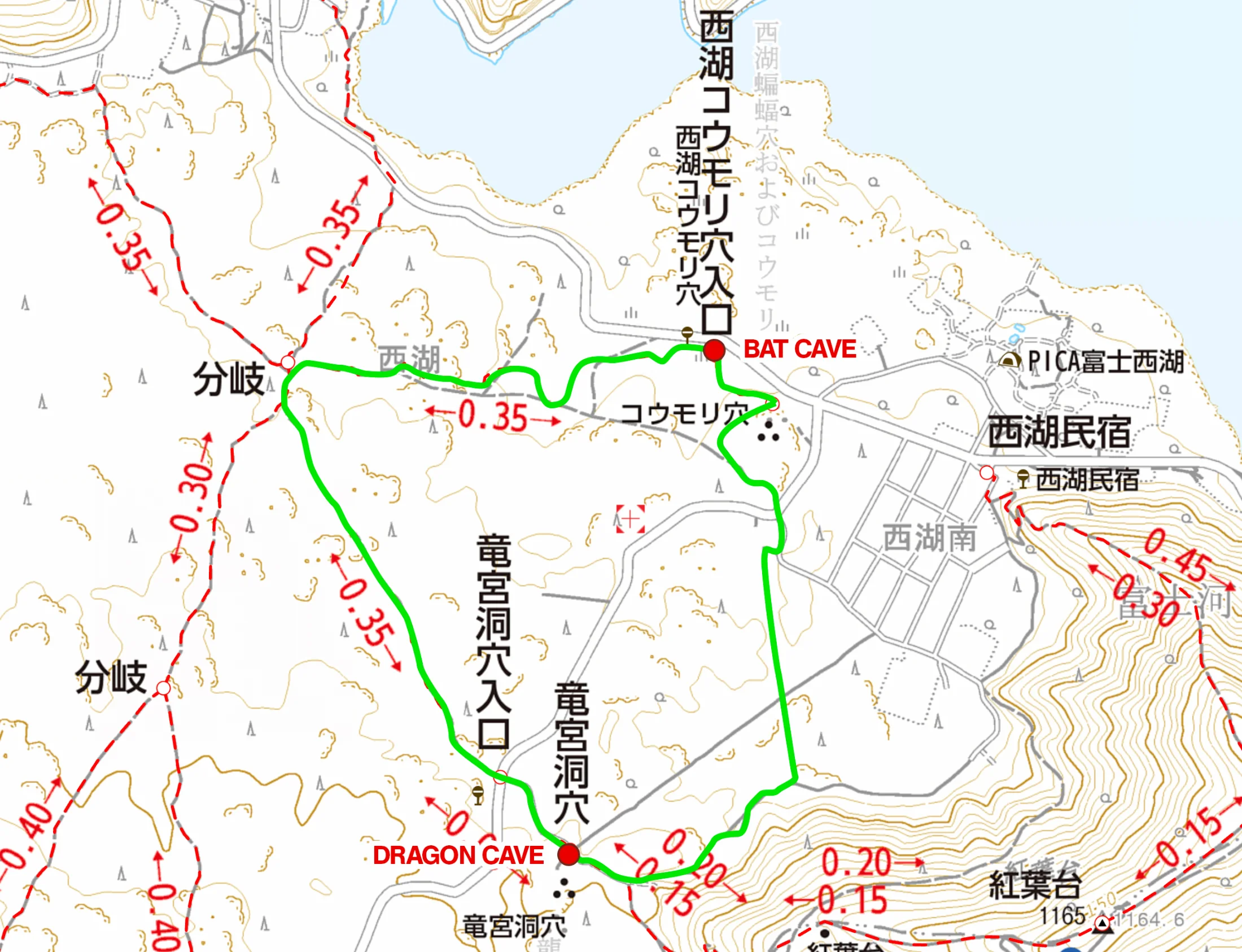
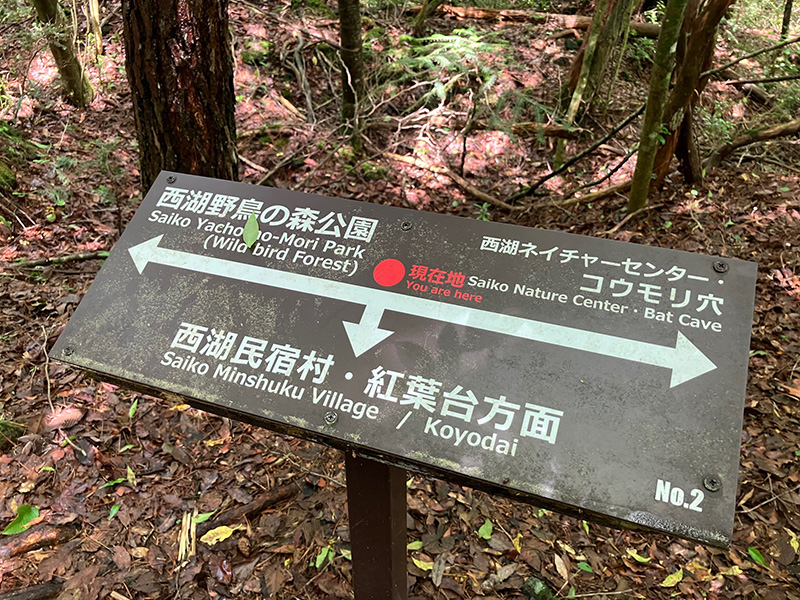
From the Bat Cave area, marked paths lead towards Saiko Wild Bird Forest Park and through the surrounding trail network.
This is a good introduction for visitors who mainly want to experience the atmosphere of the forest. The route passes exposed roots, moss-covered lava and several changes in vegetation before reaching the more open surroundings of Wild Bird Forest.
Although the trails are marked, there are several junctions. Stop at each one, read the destination signs carefully and make sure the arrow corresponds to the route you intend to follow.
Towards Ryugu Cave
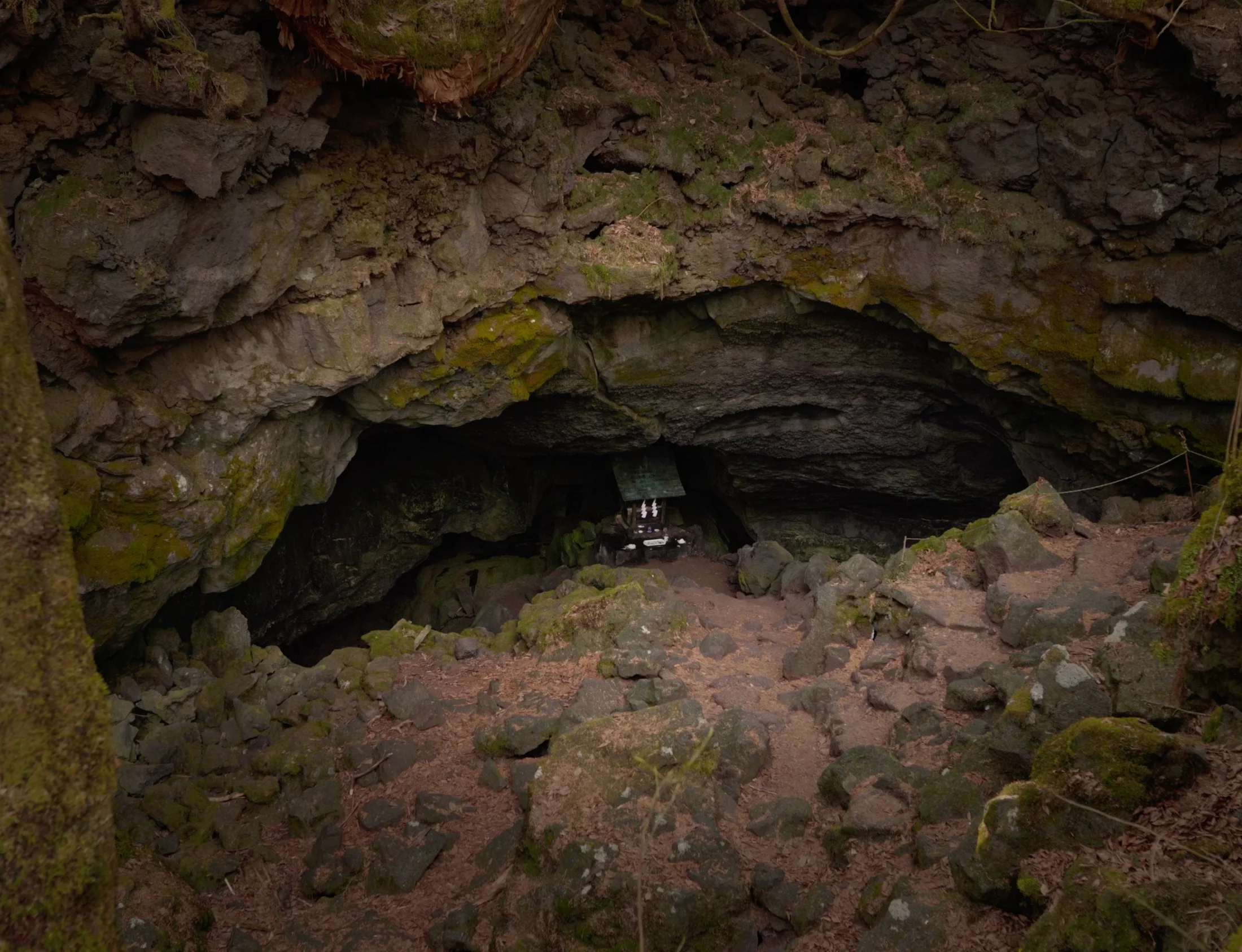
Another marked trail leads from the Bat Cave area towards Ryugu Cave, passing through a quieter section of the forest.
Ryugu Cave — sometimes translated as the Dragon Cave — is a lava cave associated with a small shrine and local religious traditions. It is not an adventure cave to enter freely. Visitors should remain in the designated area, respect any barriers and treat the site as both a natural monument and a sacred place.
Walking times vary considerably depending on the exact path chosen, the conditions and the amount of time spent observing the forest. Check the current signs and trail information locally before setting out rather than relying on a fixed duration found online.
Is it safe to walk in Jukai?
Walking on the official trails is accessible to most reasonably active visitors in suitable weather. The main risks are much more ordinary than the stories surrounding the forest suggest: losing the marked path, tripping on roots, slipping on wet lava or underestimating the time needed to return.
A maintained trail is not necessarily a smooth trail. Even on relatively easy routes, the ground can be uneven and dark under the canopy.
The most important rule: never leave the marked trail.
If you become uncertain about your position, return to the last sign or junction you clearly recognised. Do not continue simply because another path appears to lead in the right direction.
A few simple precautions make a significant difference:
- Remain on the marked walking paths at all times.
- Begin early enough to finish well before dark.
- Wear closed shoes with good grip.
- Carry water and an additional layer, even when the lakeside feels warm.
- Carry a bear bell, particularly when the trails are quiet.
- Check the weather and avoid the forest during strong winds, heavy rain, snow or icy conditions.
- Do not depend entirely on mobile reception or an online map.
- At junctions, confirm your direction before continuing.
- Keep children close, especially around roots, holes and cave areas.
- Tell someone which route you plan to follow if walking independently.
About bears in Jukai
Japanese black bears live in the wider Fuji area and may occasionally pass through Jukai. Although it is not their most frequently encountered habitat, their presence should not be ignored. We have previously seen bear tracks during walks in the forest.
Carrying a bear bell is recommended because it announces your presence while you move and reduces the chance of surprising an animal at close range.
This does not prevent you from experiencing the quiet of Jukai. You can stop occasionally, remain still and listen to the forest before continuing along the trail.
If you see a bear, remain calm. Do not run, shout, approach it or attempt to take photographs. Keep your distance and withdraw slowly without turning your back.
How to behave responsibly
Jukai is a protected natural environment, not an open space where visitors can wander anywhere they choose.
The most important rule is to stay on the trail. Leaving it does not only increase the chance of becoming lost. It can crush moss, damage shallow roots and disturb areas that recover very slowly.
Please also remember to:
- Take all rubbish back with you.
- Do not collect lava, moss, plants, branches or other natural material.
- Never carve, scratch or peel bark from trees.
- Do not move stones or create your own trail markers.
- Avoid entering unmaintained holes or caves.
- Keep your distance from wildlife and never feed animals.
- Keep voices and music low.
- Respect shrines, barriers and restricted areas.
- Follow temporary closures or instructions displayed locally.
Silence is not a strict requirement, but it is part of experiencing this forest well. Avoid unnecessary shouting or amplified music, while remembering that a bear bell serves a genuine safety purpose.
Getting there without a car
The Saiko Sightseeing Bus, usually identified as the Green Line, connects Kawaguchiko Station with Saiko Bat Cave, Wild Bird Forest and other locations around Lake Saiko.
Get off at Saiko Bat Cave for the Nature Center and the main trail entrance described in this article. Wild Bird Forest also has its own bus stop.
Bus schedules can change, and services around Lake Saiko are less frequent than those around central Kawaguchiko. Check the current route and timetable before starting your walk, including the time of your return bus.
By car, Saiko Nature Center provides a convenient starting point. Use designated parking areas rather than stopping along the forest roads.
Kawaguchiko Station → Green Line → Saiko Bat Cave
Check the current bus timetable
When to visit
Spring, summer and autumn are the most straightforward seasons for walking.
Spring brings fresh vegetation, while summer offers shade and temperatures that can feel cooler than the exposed lakeshore. Autumn changes the light and colour of the forest, although fallen leaves can hide roots and uneven ground.
Winter requires more care. Snow, ice and shorter daylight hours can change an easy trail considerably. Saiko Bat Cave itself is currently listed as closed from December 1 to March 19, although dates should always be checked on the official visitor information page before travelling.
Walking independently or with a guide
If your goal is simply to enjoy a short forest walk, the official paths around Saiko Bat Cave provide a good place to begin independently.
A guided walk becomes more valuable when you want to understand why the forest looks the way it does: how the lava shaped the land, how plants survive with so little soil, what the cave sites represent and which small details would otherwise go unnoticed.
Explore Jukai with a local guide
NaturaBase offers a guided forest walk for visitors who would prefer to follow an official route while learning more about the volcanic landscape, vegetation and local history.
FTC BOOKING PORTALCheck availability hereHowever you choose to visit, Jukai is best approached without rushing. Stay on the trail, leave the forest as you found it and take the time to listen.
For safety and access context before you go, see What You Should Know Before Entering Jukai.