
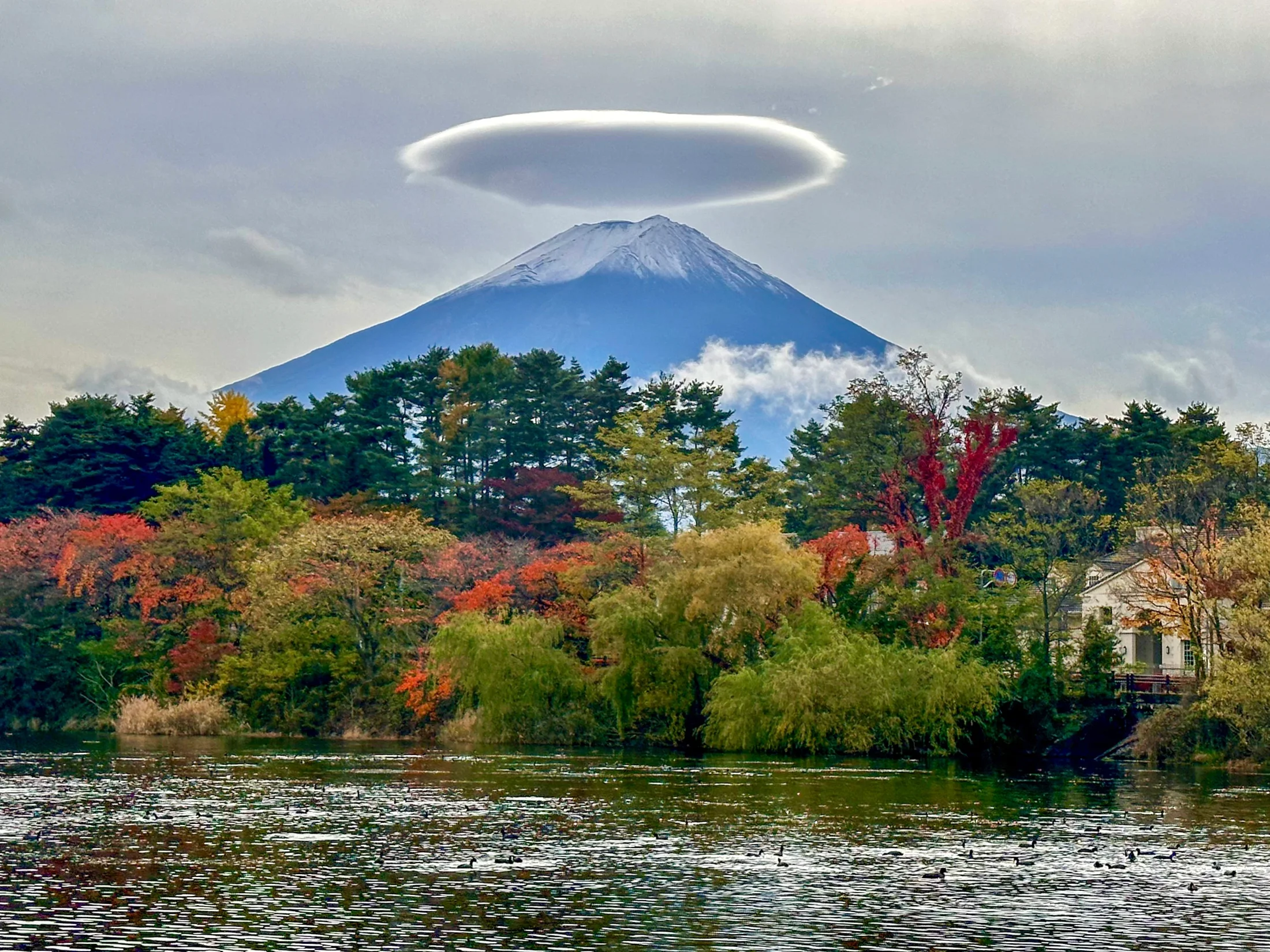
Mount Fuji is a volcano, so it may seem strange that UNESCO lists it as a World Cultural Heritage Site rather than a natural one.
The distinction makes more sense once you understand what was actually inscribed.
UNESCO did not recognise Mount Fuji simply because it is a large, beautiful or geologically interesting mountain. It recognised a relationship that has developed over centuries between the mountain and the people who worshipped it, climbed it, travelled around it and represented it in art.
The World Heritage Site is officially called “Fujisan, sacred place and source of artistic inspiration.”
That name is the key to understanding the designation.
The short version
Mount Fuji became a World Cultural Heritage Site in 2013 because UNESCO recognised two main things.
First, Fuji has been the centre of a long and still-living tradition of mountain worship. People climbed the mountain as an act of faith, visited sacred places around its base, stayed with religious guides and developed pilgrimage routes that still shape the region today.
Second, the form of Mount Fuji became one of the most influential images in Japanese art. Works by artists including Katsushika Hokusai and Utagawa Hiroshige helped make the mountain internationally recognisable and influenced artists far beyond Japan.
So the World Heritage designation is not just about the volcano.
It is about what people have made of the volcano, and what the volcano has meant to them.
Cultural heritage does not mean “man-made”
The word cultural can be misleading here.
World Heritage Sites are not divided simply into things made by humans and things made by nature.
UNESCO evaluates sites according to their Outstanding Universal Value. Its criteria cover cultural traditions, architecture, landscapes, artistic influence, geology, ecosystems, biodiversity and other forms of significance.
A mountain can therefore be central to a cultural World Heritage Site.
In the case of Mount Fuji, the accepted UNESCO criteria concern its role in a living cultural tradition and its direct association with beliefs and internationally significant works of art.
That does not make Fuji any less natural.
It means that the cultural relationship between the mountain and people is the reason for this particular World Heritage inscription.
A sacred mountain before it was a tourist destination
Mount Fuji has not always been approached as a recreational mountain.
Its volcanic activity inspired fear as well as admiration. Over time, religious practices developed around the idea that the mountain was inhabited by powerful deities and Buddhist figures.
Shrines were established around its base, and the mountain became associated with forms of ascetic practice that combined elements of Japanese mountain worship, Buddhism and Shinto traditions.
By the 12th century, Mount Fuji had become an important place for religious training.
Climbing the mountain was not simply a journey to reach 3,776 metres. The ascent itself could be a religious act.
Pilgrims followed established routes, visited sacred places and eventually reached worship sites around the summit and crater.
Some traces of that world remain visible today.
The Yoshida Trail, for example, does not begin at the modern Fifth Station. Its historical route begins much lower on the mountain, connected to Kitaguchi Hongu Fuji Sengen Shrine and the old pilgrim town of Yoshida.
Fuji-ko expanded the pilgrimage tradition
From around the 14th century, climbing Mount Fuji increasingly spread beyond religious specialists.
Later, the Fuji-ko movement made Fuji worship particularly important among ordinary people, especially during the Edo period.
Fuji-ko groups travelled to the mountain, climbed it and visited sacred places around its base.
The journey involved considerably more than the summit.
Pilgrims might undergo purification, visit lakes or springs, enter lava caves and follow circuits connecting sites associated with Fuji worship.
This created an entire human geography around the mountain.
In places such as Yoshida, now part of Fujiyoshida, pilgrims were received by people known as Oshi.
Oshi were religious guides who also provided accommodation, food, prayers and practical arrangements for pilgrims, including later Fuji-ko groups.
At the height of the pilgrimage culture, dozens of Oshi lodging houses lined the old approach through Yoshida.
Two surviving Oshi residences are included in the World Heritage property today.
The World Heritage Site is much larger than the summit
This is one of the easiest things to misunderstand about Mount Fuji's UNESCO designation.
The World Heritage Site is not simply the summit or the cone of the mountain.
It is a serial property made up of 25 component parts in Yamanashi and Shizuoka.
They include the mountain and historical ascending routes, Sengen shrines, Oshi lodging houses and places connected to pilgrimage and purification.
They also include natural features.
Among them are lakes, springs, waterfalls, lava tree moulds and other parts of the volcanic landscape.
All five of the Fuji Five Lakes are included in the World Heritage property.
That may initially seem strange for a cultural listing, but historically the lakes were not simply scenic places. They were part of the religious landscape around the mountain.
Fuji-ko pilgrims practised circuits of sacred waters around Mount Fuji, and the lakes formed part of this geography of purification and pilgrimage.
Oshino Hakkai, the group of spring-fed ponds between Fujiyoshida and Yamanakako, has a similar connection with Fuji worship.
The distinction between “nature” and “culture” becomes much less clear once you look at the region this way.
The water, caves, forests and volcanic formations were natural, but the meanings people attached to them were cultural.
A mountain that shaped art
The second major reason for the UNESCO inscription is artistic.
Mount Fuji has appeared in Japanese literature and visual culture for centuries.
Its unusually recognisable profile made it a recurring subject in poetry, paintings, decorative arts and later woodblock prints.
In Edo-period art, Fuji also appeared within scenes of everyday life rather than only as an isolated sacred mountain.
The most famous example is Katsushika Hokusai's Thirty-Six Views of Mount Fuji.
Hokusai repeatedly placed the mountain behind waves, villages, workers, roads and changing weather. Sometimes Fuji dominates the composition; sometimes it is a small shape far in the distance.
Utagawa Hiroshige also produced influential views of the mountain.
These images travelled far beyond Japan during the 19th century.
UNESCO specifically recognises the influence that the work of Hokusai and Hiroshige had on the development of Western art.
The familiar image of a solitary Fuji rising above water or landscape became not only a Japanese symbol, but an internationally recognised one.
Why wasn't Mount Fuji listed as natural heritage?
There was, in fact, an earlier movement in Japan to pursue World Natural Heritage status for Mount Fuji.
That history is sometimes reduced to a simple story that “Fuji could not become a natural World Heritage Site because there was too much rubbish.”
That is incomplete.
Natural World Heritage status has its own demanding criteria. A site must demonstrate Outstanding Universal Value through areas such as exceptional natural phenomena, geological history, ecological processes or biodiversity.
Japanese discussions about a natural nomination also considered issues including how Mount Fuji compared with similar volcanic landscapes elsewhere, the degree of development around the mountain and environmental problems including waste.
Japan ultimately did not advance Mount Fuji through that route.
The successful nomination followed a different argument.
Rather than asking whether Fuji's volcanic geology was sufficiently exceptional on a global natural-heritage scale, the cultural nomination examined something much more distinctive: the extraordinary depth of the relationship between this particular mountain, religious practice and artistic representation.
That is the case UNESCO accepted in 2013.
Cultural status does not reduce the importance of nature
The cultural designation should not be read as saying that Mount Fuji's natural environment is secondary or unimportant.
Much of the mountain is also protected through other systems, including Fuji-Hakone-Izu National Park and national designations for landscapes and natural features.
UNESCO itself notes that the natural setting is essential to the cultural value of the property.
Without the volcano, its water systems, forests and views, the pilgrimage and artistic traditions would not exist in the same form.
The cultural heritage of Fuji depends on the mountain remaining a mountain.
What this changes when you visit
Understanding the World Heritage designation changes the way the Fuji area makes sense.
Kitaguchi Hongu Fuji Sengen Shrine is not simply another attractive shrine near Mount Fuji. It stood at the entrance to an important pilgrimage route.
The old Oshi houses in Fujiyoshida are not ordinary historic homes. They are surviving pieces of the infrastructure that supported generations of pilgrims.
The Yoshida Trail is not only a modern climbing trail. It follows a much older route of religious ascent.
Oshino Hakkai is not included simply because its ponds are clear and photogenic.
And the Fuji Five Lakes are not just five places from which to photograph the mountain. They were also part of a wider sacred landscape.
The 25 World Heritage components make much more sense when they are viewed as parts of one system rather than as a collection of unrelated attractions.
You do not need to climb Fuji to experience its World Heritage
One useful consequence of this is that experiencing Mount Fuji as a World Heritage Site does not require reaching the summit.
Much of the story exists around the foot of the mountain.
You can walk through the old pilgrimage area of Fujiyoshida, visit Sengen shrines, see surviving Oshi houses, explore the lakes and springs, or follow the relationship between Fuji and the surrounding landscape.
In some ways, these places explain the World Heritage designation more clearly than the modern summit climb does.
The mountain is the centre of the story, but the heritage exists in the connections around it.
So why is Mount Fuji cultural heritage?
Because UNESCO did not inscribe only a volcano.
It recognised a mountain that people have feared, worshipped, climbed, travelled around, written about and depicted for centuries.
Mount Fuji's natural form made all of that possible.
But the World Heritage value lies in the culture that developed around that form.
That is why its official name is not simply “Mount Fuji.”
It is “Fujisan, sacred place and source of artistic inspiration.”
And once you understand that, many places around the Fuji Five Lakes that initially seem unrelated start to become parts of the same story.
Practical note
The World Heritage property extends across both Yamanashi and Shizuoka prefectures and contains 25 component parts.
You do not need to visit them all.
For visitors staying around the Fuji Five Lakes, some of the easiest places to begin understanding the cultural landscape are the historical pilgrimage area in Fujiyoshida, Kitaguchi Hongu Fuji Sengen Shrine, the Fuji Five Lakes and Oshino Hakkai.
The Yamanashi Prefectural Fujisan World Heritage Center also provides detailed interpretation of the pilgrimage routes, Fuji-ko, Oshi and the individual World Heritage components.