
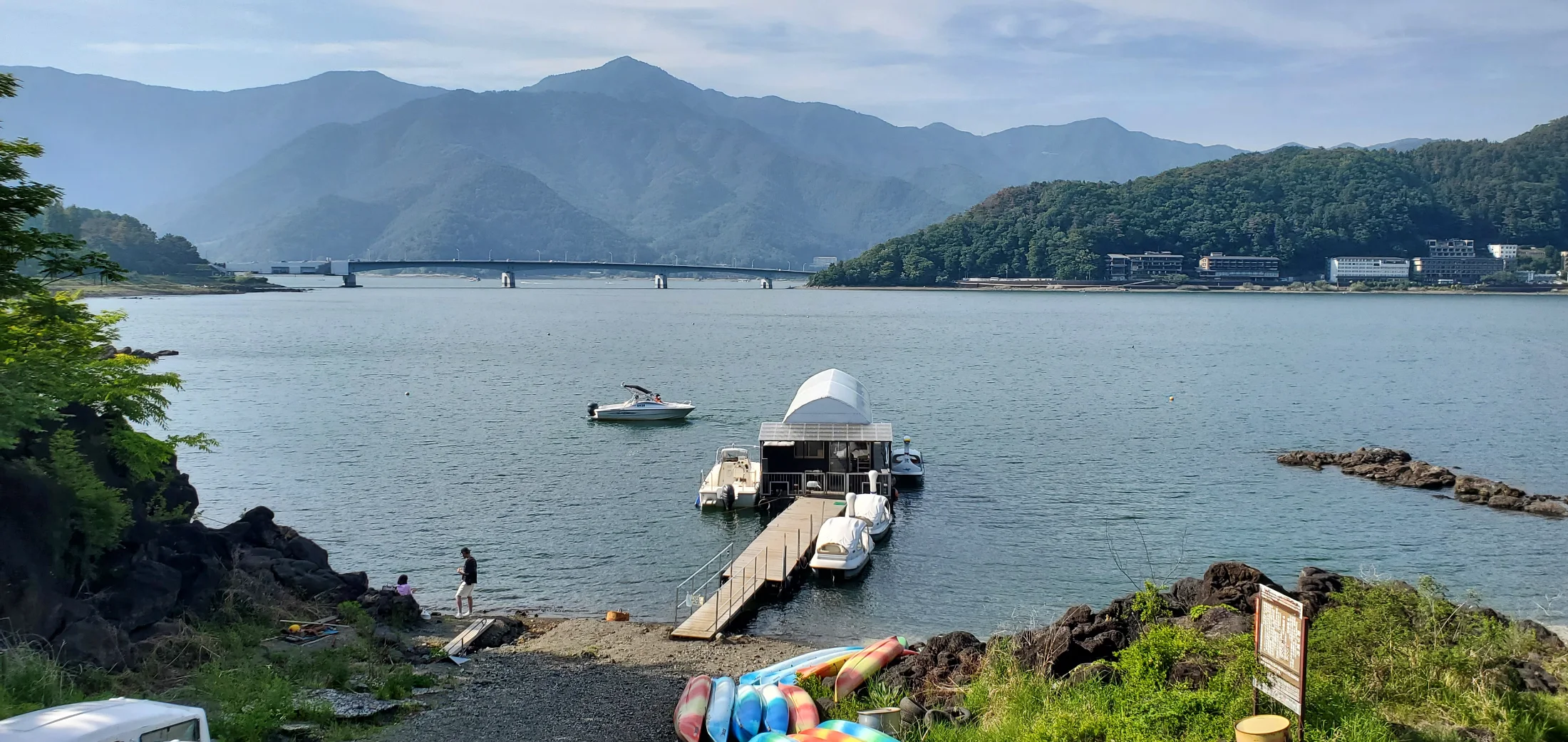
The short version
If this is your first visit to the Fuji Five Lakes, Lake Kawaguchiko is usually the easier place to stay, particularly if you are travelling without a car. Kawaguchiko Station is a transport hub, several sightseeing bus routes start there, and it is relatively easy to build a day around different parts of the lake or continue toward Saiko and the western lakes.
Yamanakako makes more sense when the lake, outdoor activities and the accommodation itself are a larger part of the stay. Cycling, camping, boating and other lakeside activities feature strongly around Yamanakako, but where you choose to stay matters. The village is spread around different parts of the lake rather than organised around one obvious visitor centre.
Neither lake is simply better. Kawaguchiko gives you more flexibility. Yamanakako rewards a more deliberate choice of where to stay and what you want to do there.
- Choose Kawaguchiko for a first visit, a car-free trip, varied sightseeing or a flexible regional base.
- Choose Yamanakako for cycling, camping, water activities or a stay focused more closely on the lake itself.
- Without a car, Kawaguchiko is usually easier, but the distance between your hotel and a useful bus stop still matters.
- With a car, Yamanakako becomes much easier to use without worrying as much about where around the lake you stay.
- For Mount Fuji views, do not choose between the two lakes on that basis alone. Weather and cloud often matter more than the lake you pick.
Kawaguchiko gives you more room to change your plans
The practical advantage of Kawaguchiko is not simply that it has more well-known attractions. It is that many different plans can begin from the same transport hub.
Kawaguchiko Station is the starting point for Fujikyu's Red, Green and Blue sightseeing bus routes. These connect the station with different parts of Kawaguchiko and continue toward Saiko, Narusawa, Shojiko and Motosuko. Rail and highway-bus connections also make the station an important arrival and departure point for the wider region.
That flexibility matters when a day does not go exactly as planned.
Mount Fuji may disappear behind cloud. A visitor may decide not to spend several hours at a viewpoint. Weather can make cycling less appealing, or a museum may suddenly look more attractive than another outdoor stop. Around Kawaguchiko, it is relatively easy to change the shape of the day without abandoning it entirely.
This is one reason we generally see Kawaguchiko as the simpler choice for a first visit.
Staying without a car around Kawaguchiko
Being in Kawaguchiko does not automatically mean that an accommodation is convenient without a car.
Around Kawaguchiko Station and central Funatsu, many locations remain practical on foot for travellers who do not mind walking. Beyond that, we would pay close attention to the nearest bus stop, particularly when travelling with luggage or planning early starts and later returns.
This is more important than simply seeing "Kawaguchiko" in the address.
A hotel that looks close to the lake on a map may still be awkward for a car-free traveller if reaching the relevant bus stop involves a significant walk. Conversely, accommodation farther from the station can work perfectly well when it sits near the route you actually intend to use.
The north shore is a good example. It works particularly well by bicycle because you can move between lakeside stops at your own pace. By bus it is still accessible, but the timetable and the walking distance between stops and individual places become more important.
For a car-free stay, we would look at the useful bus stop almost as carefully as the hotel itself. For a broader overview, see Getting Around the Fuji Five Lakes Without a Car.
Yamanakako works differently
Yamanakako does not have an equivalent single hub around which most visitor activity is organised.
Official tourism information divides the lake area into several parts, including Yamanaka, Asahigaoka, Nagaike and Hirano. Attractions, accommodation and outdoor areas are distributed around the lake, and the official cycling route itself connects several of these areas.
This does not make Yamanakako impractical without a car. Direct highway buses serve the area, and the Fujikko-go sightseeing bus connects Yamanakako with Oshino, Fujiyoshida and Kawaguchiko.
It does mean that choosing the right location matters more.
If you are planning to stay without a car, look at the hotel, the nearest bus stop and the activities you actually want to do before deciding which part of Yamanakako suits you.
A hotel near the right stop with a simple lakeside plan can work very well. Choosing an accommodation first and working out transport afterwards is more likely to create unnecessary walking or waiting.
Yamanakako is particularly strong for outdoor stays
The official visitor offer around Yamanakako places much more emphasis on outdoor activity than a conventional sightseeing circuit.
Cycling is one of the clearest examples. A lakeside cycling route connects different parts of the lake, including Asahigaoka, Nagaike and Hirano. Boating, canoeing, camping and other outdoor activities are also an important part of the area's identity.
That creates a different rhythm from Kawaguchiko.
At Kawaguchiko, a visitor might build a day from a ropeway, a bicycle ride, a museum, a lakeside stop and another part of the region.
At Yamanakako, it can make more sense to choose the accommodation because it puts you where you want to cycle, spend time beside the lake or take part in an outdoor activity.
The accommodation can therefore become part of the reason for choosing Yamanakako, rather than simply somewhere to sleep between sightseeing stops.
That does not mean Yamanakako is only camping or high-end hotels. Its official accommodation listings include hotels, ryokan, pensions, cottages and other types of stay. The useful distinction is not price or luxury. It is the relationship between where you sleep and how you plan to use the lake.
Do not turn Kawaguchiko into a checklist
One of the easiest ways to make a Kawaguchiko visit less enjoyable is to treat the day as a list of famous photo stops.
Distances around the lake are larger than they first appear, bus waiting time adds up, and moving repeatedly between unrelated places can consume much of the day.
In practice, a day often works better when it has one main direction.
For example, the Mount Fuji Panoramic Ropeway can combine naturally with a bicycle ride toward the north shore.
A morning activity on Lake Kawaguchiko can leave enough time for a separate afternoon in or around the Jukai forest when transport is planned properly.
For someone walking independently in the Jukai area, combining a forest walk with Iyashi no Sato can also work, but an early start and careful attention to bus schedules and walking time become important.
The point is not that these are fixed itineraries. It is that two compatible experiences usually make a better day than trying to reproduce every famous image of Kawaguchiko before sunset.
What about restaurants and the evening?
Kawaguchiko Station has places to eat nearby, but staying close to the station does not mean that every evening needs to be spent in the immediate station area.
Some local restaurants are slightly farther away, and a taxi can sometimes make more sense than choosing dinner entirely around walking distance.
This is another reason to think about accommodation as part of the transport plan. A convenient daytime location and a convenient evening location are not necessarily the same thing.
For Yamanakako, we would be more cautious about giving general advice on evening dining without knowing the exact part of the lake. Restaurants and accommodation are distributed around several areas, so this is something worth checking for the particular place where you intend to stay.
Which lake is better for one night?
For a first visit of only one night, Kawaguchiko is usually the safer default.
This is especially true without a car. It gives you several transport options, a broad range of things to do, and more flexibility if you arrive later than expected or change your plan because of the weather.
Yamanakako becomes more attractive for a one-night stay when there is already a reason for choosing it.
That might be a particular accommodation, cycling around the lake, camping, a water activity, or simply wanting the lake itself to be the centre of the stay.
In that situation, choosing Yamanakako is not sacrificing sightseeing convenience. It is choosing a different kind of trip.
Which works better for a longer stay?
Kawaguchiko is the stronger regional base if you want to explore several parts of the Fuji Five Lakes.
The sightseeing bus network makes it possible to move west toward Saiko, Shojiko and Motosuko, and Kawaguchiko Station gives you more options when you want to change direction completely.
Yamanakako can work very well for a slower stay built around outdoor activity or time beside the lake. With several nights, there is less pressure to fit cycling, water activities and other stops into a single transport schedule.
If you have a car, the difference becomes less about transport and more about what kind of environment you want to return to at the end of the day.
Do not choose only for the Mount Fuji view
Both lakes can offer remarkable views of Mount Fuji.
Neither can guarantee them.
Cloud often develops around the mountain independently of the conditions where you are standing. A clear sky over the lake does not necessarily mean the summit will remain visible, and conditions can change considerably during the same day.
For that reason, choosing Yamanakako because someone says it has "better Fuji views", or Kawaguchiko because you have seen a particular photograph online, is not a very reliable way to choose where to stay.
Think first about transport, activities and the kind of stay you want. Treat a clear view of Mount Fuji as part of the experience when the weather allows it. For more on this, see Why Mount Fuji Is Not Always Visible.
So, Kawaguchiko or Yamanakako?
Choose Kawaguchiko if you want the easiest first introduction to the region, particularly without a car. It works well when you want several different options in the same trip and do not want the whole stay to depend on one carefully planned location.
Choose Yamanakako if you already know that the lake, cycling, camping, water activities or a particular accommodation are central to your trip. It rewards choosing where you stay with more intention.
If you are still uncertain, Kawaguchiko is the more forgiving default.
But if what attracts you to the Fuji Five Lakes is not a checklist of sights and is instead the idea of spending time beside the water and outdoors, Yamanakako may be the more interesting choice. For a wider comparison, see Which of the Fuji Five Lakes Should You Visit?.